
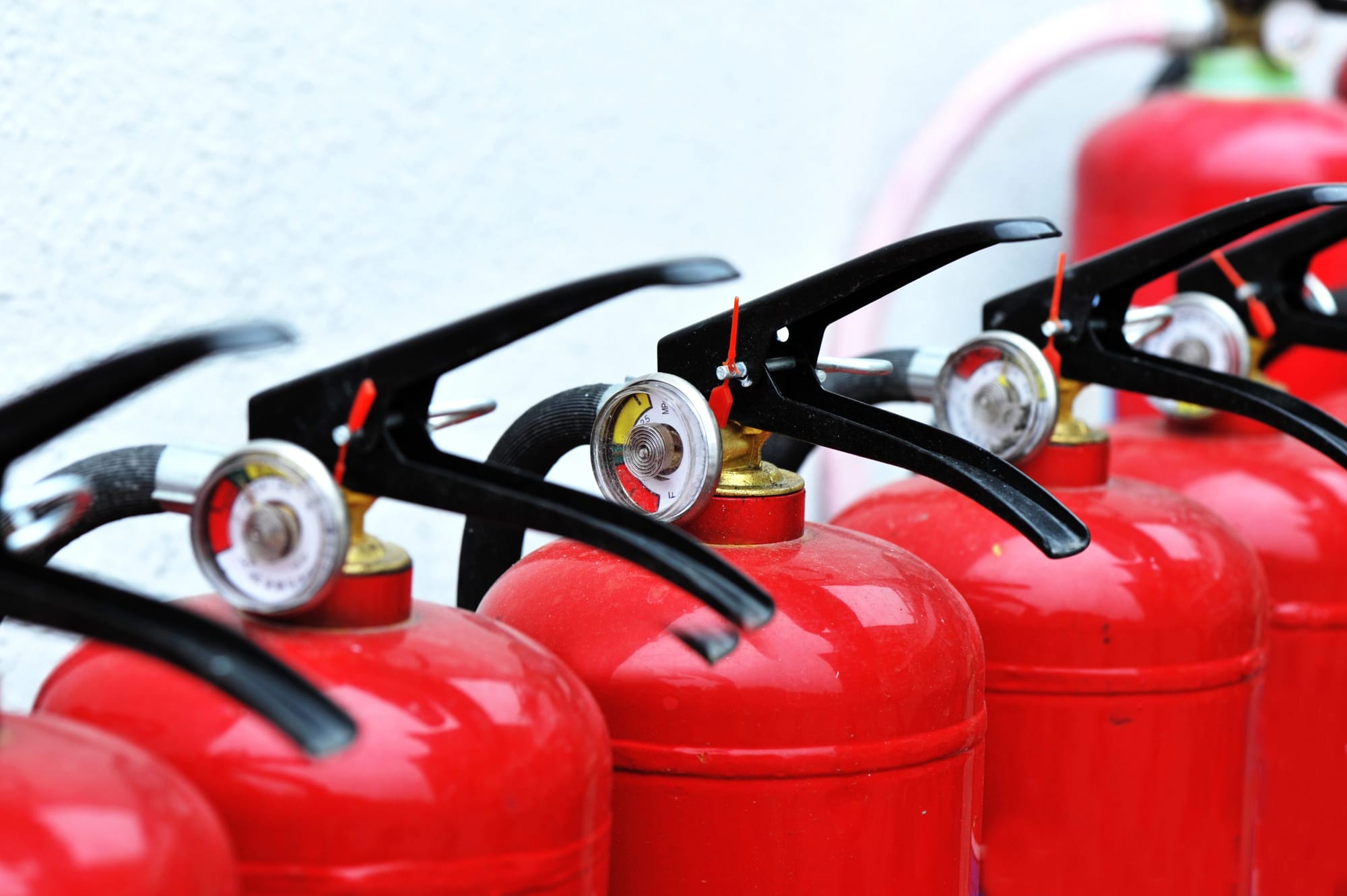
Commercial Fire Extinguisher Placement Basics for Offices, Warehouses, and Light Industrial Spaces
Most commercial buildings have fire extinguishers. But fewer have them in the right spots. Commercial fire extinguisher placement gets treated as a box to check during buildout, then rarely gets a second look until an inspector flags a gap or someone reaches for a unit and can’t find one.
When our technicians inspect a facility for the first time, missing or blocked extinguishers are one of the most common findings on the report, more common than expired tags. Whether you’re running an office, a warehouse, or a light industrial space, where you put your extinguishers matters just as much as having them at all.
Why Placement Matters More Than People Think
An extinguisher does no good if nobody can see it or reach it fast. NFPA 10, the standard governing portable fire extinguishers, sets travel distance limits for a reason: no one should have to hunt for one during a fire.
For Class A hazards (ordinary combustibles like paper, wood, and cardboard), the maximum travel distance is 75 feet. For Class B hazards (flammable liquids), it drops to 50 feet, or 30 feet in higher-hazard areas. If someone has to walk further than that to reach an extinguisher, the placement doesn’t meet code, no matter how many units are in the building.
Placement also fails in less obvious ways. An extinguisher gets moved during a renovation and never gets remounted, or a pallet gets parked in front of a wall-mounted unit “just for today.” Our inspection records show these two issues account for a large share of the deficiencies we find and correct on routine visits. Most of them didn’t start out as violations; they developed over a few busy weeks.
Placement Basics by Space Type
Different spaces come with different placement priorities, and NFPA 10 sets minimum requirements based on hazard classification, not guesswork.
Offices generally fall under light (low) hazard occupancy, which allows a single 2-A rated extinguisher to cover up to 3,000 square feet. Even so, units should sit near exits, in kitchens and break rooms, and close to concentrated electrical equipment like server rooms or copier stations, since those are the spots where small fires are most likely to start.
Warehouses typically fall under ordinary (moderate) hazard, with a 2-A unit covering up to 1,500 square feet. Larger floor plates mean extinguishers need to be spaced along main aisles and positioned near loading docks, where forklifts, packaging materials, and battery charging stations raise the risk.
Light industrial spaces often qualify as extra (high) hazard, cutting coverage to 1,000 square feet per 2-A unit, and sometimes requiring higher-rated extinguishers depending on the process. Units belong near equipment with the highest fire risk and at the work zones where staff spend the most time. If a process station involves heat, friction, or flammable materials, that’s a spot that needs coverage, not the nearest hallway.
Keeping Units Accessible
Placement only works if extinguishers stay reachable. NFPA 10 requires the top of an extinguisher weighing 40 pounds or less to sit no higher than 5 feet from the floor, and no higher than 3.5 feet for heavier units; the bottom must clear the floor by at least 4 inches. A clear zone in front of each unit matters just as much as the mounting height. Nothing should ever lean against a fire extinguisher location, even temporarily.
Seasonal storage is a common culprit here. Holiday inventory, event materials, and overflow stock tend to land wherever there’s open floor space, which is often right in front of a mounted unit. A quick walk-through before busy seasons catches this before it becomes a violation.
Building a Simple Location Map for Staff
A basic map showing extinguisher locations, exits, and assembly points helps new hires get oriented fast and removes the guesswork during an emergency. It doesn’t need to be complicated, just a simple floor plan posted somewhere staff already look.
Update the map whenever the space changes, whether extinguishers get moved during a renovation or a warehouse layout shifts. Pairing that update with your next scheduled fire extinguisher inspection service call keeps the map, the paperwork, and the units in sync instead of drifting apart. Our technicians can flag any placement that’s fallen out of code during that same visit, so the fix happens before it turns into an inspection finding.
Staying Ahead of It
Extinguisher placement isn’t a one-time setup. It holds up only when someone keeps checking it against how the space is actually being used, and against what NFPA 10 actually requires, not just what fit during buildout.
Anderson Fire Protection: Your Trusted Partner for Commercial Fire Protection
Anderson Fire Protection, a certified minority-owned and women-owned small business, has been protecting residential units and businesses throughout the Mid-Atlantic for over 35 years. We take pride in our commitment to best-in-class customer service and high-quality results. Put our expertise to work for you.
Give us a call at (410) 796-4915 to speak with our team, or fill out our online contact form here and we’ll be in touch shortly.